










Technics Wireless Earbuds: Noise Cancelling, Dolby Atmos, and Spatial Audio Explained
Technics has built a reputation for packing serious audio engineering into true wireless earbuds, and the EAH-AZ100 sits at the top of that lineup. These are noise-cancelling Bluetooth earbuds that bring together Dolby Atmos spatial audio, AI-driven sound adaptation, and a compact in-ear design. The result is a pair of wireless earbuds aimed at listeners who want more than basic playback — people who care about how a mix is presented, how clearly a call comes through, and how comfortably a bud sits during a long day of use.
This review walks through what the EAH-AZ100 actually offers based on its stated specifications, what those features mean in practice, and who is likely to get the most out of them.
Design and Fit
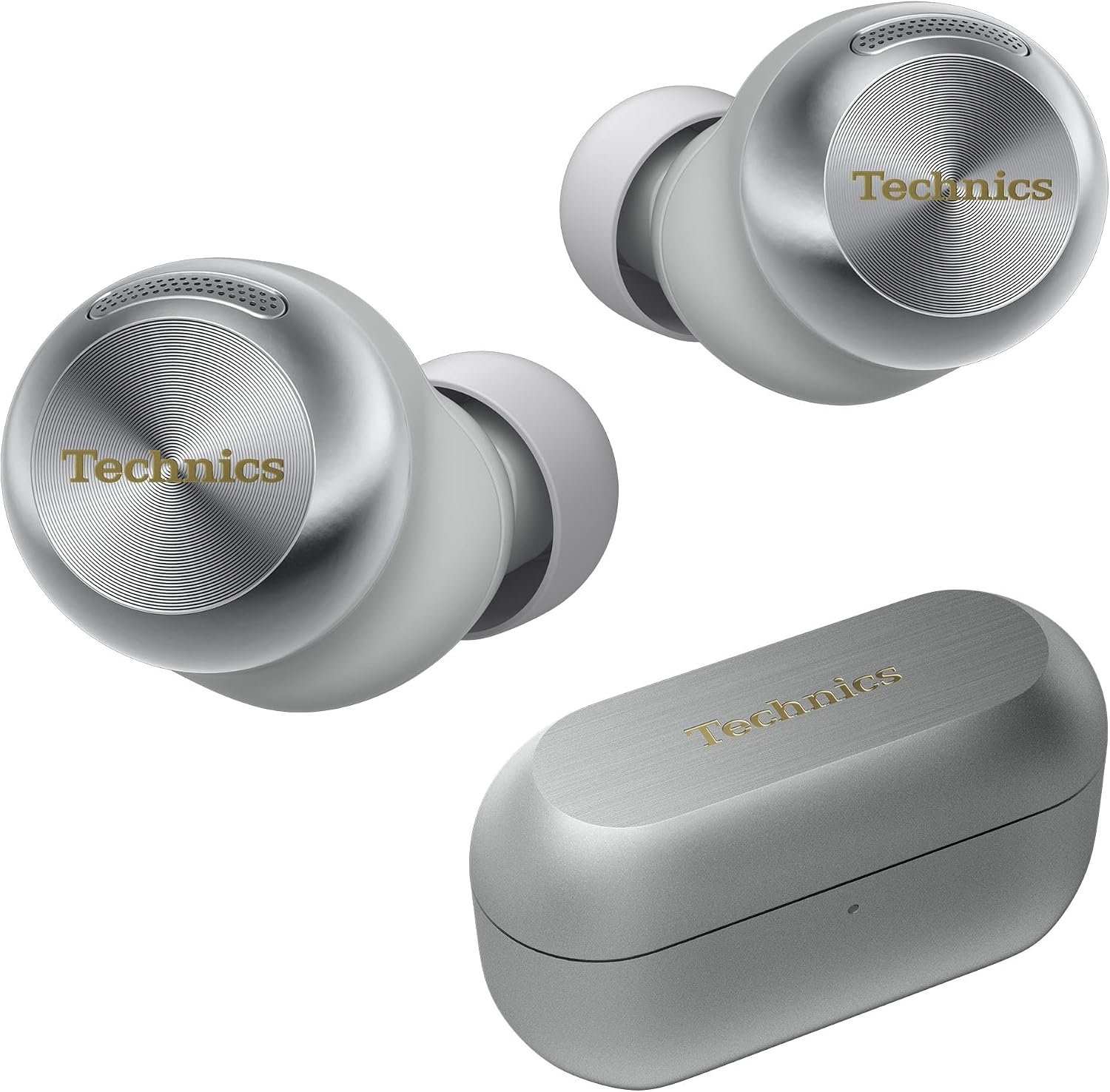
The EAH-AZ100 uses a lightweight in-ear format, and Technics states that each earbud is 10% smaller and 16% lighter than the EAH-AZ80, the previous model in the line. That reduction matters more than it might sound. A lower-profile shape is described as fitting the contours of the ear, which is the kind of design choice that affects how a bud settles in place over hours rather than minutes.
The stated goal is lasting comfort — Technics describes the fit as secure enough for all-day wear, and specifically mentions the gym, the commute, and the workday as scenarios the earbuds are designed around. Those are three very different environments: one involves movement and sweat, one involves ambient noise and transit, and one involves long stretches of seated focus. A design that claims to hold up across all three is making a broad comfort and stability statement rather than a narrow one.
Because the housing is smaller and lighter than the AZ80, the EAH-AZ100 is positioned as a more discreet option for listeners who found the earlier generation bulky or prone to working loose. The compact form also supports the portability angle — these are earbuds meant to travel in a pocket or bag without much bulk.
Features and Technology
The headline technology here is Dolby Atmos with head tracking. This is spatial audio in the sense that the sound field is designed to respond to head movement: when you turn left, the audio is presented as coming from your right. That kind of positional behavior is what separates spatial audio from ordinary stereo playback, and Technics frames it as being particularly relevant for movie watching and music listening where immersion is the point.
Layered on top of that is AI-powered spatial audio. Technics describes the earbuds as using AI technologies that adapt sound to the surrounding environment, which is a broad claim about how the audio presentation responds to context rather than a fixed tuning.
For the core sound engine, the EAH-AZ100 uses magnetic fluid drivers. According to the supplied information, these are designed to deliver low distortion, accurate bass, smoother mid-high frequencies, and a wide range of sound. Technics also describes the overall presentation as high-resolution, with rich bass, smooth mids, and clear highs. These are stated characteristics of the driver design rather than measured results, but they point to a tuning philosophy built around balance across the frequency range rather than a single boosted band.
Noise cancellation is handled adaptively. Rather than applying one fixed level of cancellation, the earbuds automatically respond to the environment to adjust performance. That means the cancellation behavior can shift as you move from a quiet office to a noisy street without manual intervention.
Call quality is addressed through a Voice Focus AI chip, which Technics states supports clear hands-free communication. The scenarios named include board meetings, remote work, and commuting — in other words, both quiet professional settings and noisy public ones.
Performance and Everyday Experience
Pulling the features together, the EAH-AZ100 is positioned as a pair of earbuds that adapts rather than one that asks you to adapt. Adaptive noise cancellation handles the listening environment. AI spatial audio and head tracking handle the presentation. Voice Focus AI handles the microphone side of calls. Each of these is a separate system, but they share the same underlying idea: the earbuds respond to conditions rather than requiring the listener to reconfigure settings constantly.
For movie and music listeners, the Dolby Atmos and head-tracking combination is the most distinctive part of the package. Head tracking is what makes spatial audio feel anchored to a position rather than fixed to your ears, and Technics explicitly calls this out as a benefit for immersion. Whether that matters to you depends on how much time you spend watching video on a phone, tablet, or laptop with earbuds in.
For work and calls, the Voice Focus AI chip and the adaptive noise cancellation work in tandem — one addresses what you hear, the other addresses what the person on the other end hears. The named use cases of remote work and board meetings suggest Technics sees these as credible tools for professional communication, not just casual chat.
Battery, Connectivity, and Compatibility
Battery life is stated at up to 10 hours of music playback with noise cancellation enabled, extending to up to 28 hours total when the charging case is included. That split is worth noting: the 10-hour figure is with ANC active, which is the more demanding configuration, and the 28-hour figure reflects the combined capacity of the earbuds plus the case. For most daily routines, the case figure is the more relevant number since it determines how often you need to reach for a charger.
Connectivity is handled through Bluetooth, and the EAH-AZ100 supports 3-device multipoint pairing. That means the earbuds can maintain connections to three Bluetooth devices at once, with the ability to switch between them. Technics also notes that the multipoint connection lets you prioritize devices, which is useful when a laptop, phone, and tablet are all in play and you want calls to take precedence over media.
Technics describes the pairing as easy switching between Bluetooth devices. The earbuds are referred to in the supplied information as auriculares bluetooth inalámbricos, which is simply the Spanish term for wireless Bluetooth earbuds — a detail that reflects the product’s international positioning rather than any additional feature.
Who Is This Product Best For?
Based on the stated features and use cases, the EAH-AZ100 is aimed at a few overlapping groups:
- Commuters and travelers who want adaptive noise cancellation that responds to changing environments, plus a compact, lightweight design that travels easily.
- Remote workers and professionals who take calls regularly and want a Voice Focus AI chip handling voice clarity, with multipoint pairing to move between a laptop and phone.
- Movie and music listeners who value Dolby Atmos, head tracking, and spatial audio as part of the listening experience rather than an afterthought.
- Gym and workout users who need a secure in-ear fit that Technics describes as suitable for movement.
- Listeners upgrading from the EAH-AZ80 who want a smaller, lighter earbud with the same family of Technics audio technologies.
Anyone who primarily wants a simple set of earbuds for casual background listening may find the feature set here more elaborate than necessary. The EAH-AZ100 is built around adaptation and immersion, and those features are most valuable when you actually use them.
Final Verdict
The Technics EAH-AZ100 brings together several distinct technologies into a single pair of true wireless earbuds: Dolby Atmos with head tracking, AI-powered spatial audio, magnetic fluid drivers, adaptive noise cancellation, Voice Focus AI for calls, and 3-device multipoint pairing. The design is smaller and lighter than the EAH-AZ80, with a lower-profile shape intended to fit the contours of the ear for extended wear.
Battery life is stated at up to 10 hours with noise cancellation on and up to 28 hours with the charging case, which keeps the earbuds usable across a full day and beyond without constant charging. The combination of adaptive noise cancellation and AI-driven audio adaptation means the listening experience is designed to shift with your surroundings rather than stay fixed.
For listeners who want spatial audio, strong call handling, and a compact fit in one package, the EAH-AZ100 is a well-rounded option worth considering. Those who prefer a simpler, more traditional earbud experience may not need everything it offers — but for anyone who will use the spatial audio, multipoint, and adaptive cancellation features regularly, the feature set lines up with the way the earbuds are meant to be used.