
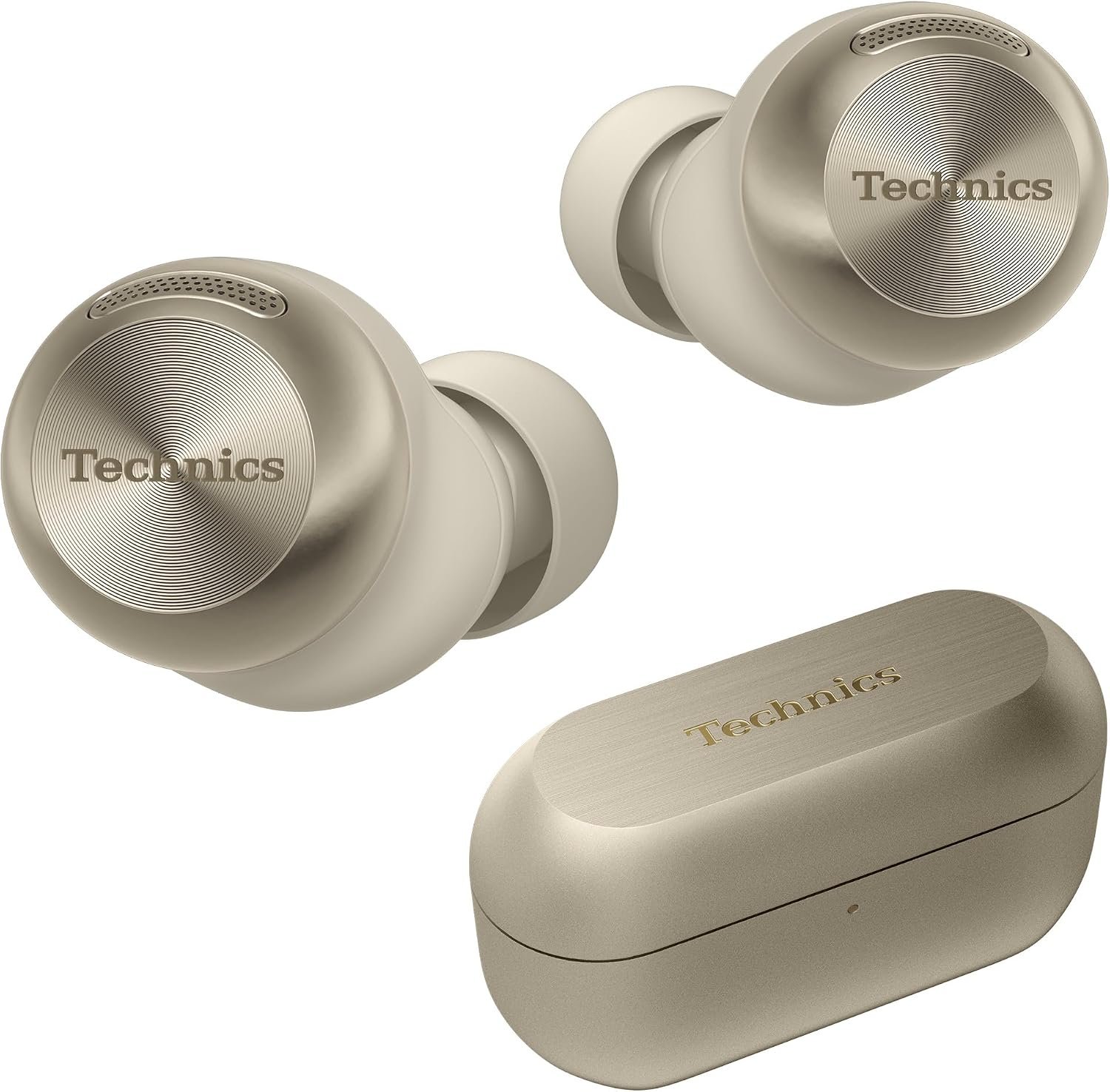





Technics Wireless Earbuds, Noise Cancelling Dolby Atmos Bluetooth Earbuds
The Technics AZ100 sits at the top of the brand’s true wireless lineup, and the feature list makes clear that this model is aimed at listeners who want more than basic audio playback from a pair of earbuds. Between AI-driven sound adaptation, Dolby Atmos with head tracking, adaptive noise cancelling, and a redesigned physical shape, the AZ100 packs a substantial set of technologies into a compact form. This review walks through what the supplied product information actually tells us about each of those elements and what they mean in practical use.
Design and Fit
Technics describes the AZ100 as 10 percent smaller and 16 percent lighter than the award-winning EAH-AZ80 earbuds. That comparison matters because it gives a concrete reference point rather than a vague claim of improvement. The earbuds also use a lower-profile shape that Technics says is designed to fit the contours of the ear.
A smaller, lighter, lower-profile build has an obvious practical dimension for true wireless earbuds: less mass pressing against the ear and a shell that sits closer to the head. For anyone who found earlier generations of larger earbuds awkward to seat or prone to feeling bulky over long sessions, the reduced footprint is a meaningful design change on paper. The supplied information does not specify materials, water resistance ratings, or the range of ear tip sizes included, so those details remain unconfirmed here.
Features and Technology
The headline feature set of the AZ100 revolves around adaptation. Technics states that the earbuds use AI technologies that adapt sound to your environment, describing the result as an unrivaled listening experience with immersive listening and seamless calls whether you are in a board room or outdoors. That framing suggests the earbuds are intended to adjust their behavior automatically rather than requiring manual tuning every time the surroundings change.
Spatial audio is the second major pillar. These are Dolby Atmos earbuds with head tracking, which Technics describes as advanced spatial audio for total immersion. The head tracking element responds to head movement, so when you turn your head to the left, sounds are presented from the right. This is the kind of behavior that mimics a fixed speaker arrangement in a room, and Technics specifically calls out movie and music lovers as the audience that benefits most.
On the audio hardware side, Technics points to magnetic fluid drivers. According to the product information, these provide low distortion, accurate bass, smoother mid-high frequencies, and a wide range of sound. These are stated product claims rather than independently verified results, but they describe the engineering intent behind the driver design: tighter control of driver movement in pursuit of cleaner output across the frequency range.
Noise cancelling is handled adaptively. Technics says the auto noise-cancelling technology responds to the environment for highest performance, meaning the level of cancellation is not fixed but shifts with conditions. A Voice Focus AI chip is also included, and Technics states it ensures clear voice call quality. Together, these two elements address both sides of a call: what you hear and what the person on the other end hears.
Connectivity and Multipoint
The AZ100 supports a 3-point multipoint connection, which Technics describes as letting you prioritize devices. In practice, multipoint pairing allows the earbuds to stay connected to more than one source at once, and a three-point implementation extends that to three devices. The ability to prioritize which device takes precedence is a useful detail for anyone juggling a laptop, a phone, and perhaps a tablet during a working day.
Bluetooth is the connection standard, as indicated in the product title. The supplied information does not list specific Bluetooth versions, supported codecs, or the exact wireless range, so those specifics cannot be confirmed from the available details.
Battery Life
Technics rates the AZ100 at up to 10 hours of playback with noise cancellation enabled, and up to 28 hours in total when the charging case is factored in. Those figures apply specifically to noise-cancelling use, which is typically the more power-hungry mode, so the stated numbers represent a realistic scenario rather than a best-case measurement with features switched off.
Ten hours in a single sitting covers a full workday, a long-haul flight, or an extended study session without a trip back to the case. The 28-hour combined figure extends that across multiple days of typical use before the case itself needs recharging. The supplied information does not specify charging times, whether wireless charging is supported, or what quick-charge options exist, so those points remain open.
Performance and Everyday Experience
Pulling the stated features together, the AZ100 is positioned as a pair of earbuds that adjusts to context rather than asking the listener to adjust it. Adaptive noise cancelling reacts to changing surroundings, the AI sound adaptation is described as tailoring output to the environment, and the Voice Focus AI chip targets call clarity. For someone moving between a quiet office, a noisy commute, and outdoor spaces in the same day, that automatic behavior is the core appeal.
The Dolby Atmos and head tracking combination points toward media consumption in particular. Head tracking is most noticeable when watching film or video content, where a stable sense of direction reinforces the spatial mix. Technics explicitly frames this as suited to movie and music lovers, which aligns with how the feature is typically experienced.
The magnetic fluid driver claims speak to the fundamentals of sound reproduction, and the multipoint connection addresses the practical reality of switching between devices. None of these elements exist in isolation; together they describe a product built around flexibility in both sound and connectivity.
Who Is This Product Best For?
Based on the supplied information, the AZ100 is aimed at listeners who want spatial audio with head tracking, particularly for movies and music. The Dolby Atmos implementation and the explicit mention of film and music enjoyment make that the clearest use case.
It also suits people who take calls in varied environments. The Voice Focus AI chip and adaptive noise cancelling are both directed at call quality and environmental noise, and Technics references settings from the board room to the outdoors.
Finally, the 3-point multipoint connection and the stated battery figures make the AZ100 a reasonable consideration for anyone who works across several devices and wants long playback sessions with noise cancelling active. Those who previously used the EAH-AZ80 and wanted a smaller, lighter alternative are also directly addressed by the size and weight comparison Technics provides.
Final Verdict
The Technics AZ100 brings together a specific set of technologies: AI-based sound adaptation, Dolby Atmos with head tracking, adaptive noise cancelling, a Voice Focus AI chip for calls, magnetic fluid drivers, and 3-point multipoint connectivity. The physical redesign makes it 10 percent smaller and 16 percent lighter than the EAH-AZ80, with a lower-profile shape intended to follow the contours of the ear, and the battery is rated at up to 10 hours with noise cancelling or 28 hours with the case.
What the supplied information does not cover is equally worth noting. Details on materials, water resistance, codec support, charging specifics, and the exact behavior of the AI adaptation in different environments are not provided, so buyers who need those specifics should verify them separately. On the strength of what is stated, the AZ100 reads as a feature-dense option for listeners who value spatial audio, automatic noise management, and multi-device flexibility in a smaller and lighter package than its predecessor.